
Implementation of ISO 21001: 2018 in postgraduate academic programs
DOI:
https://doi.org/10.22517/23447214.24735Abstract
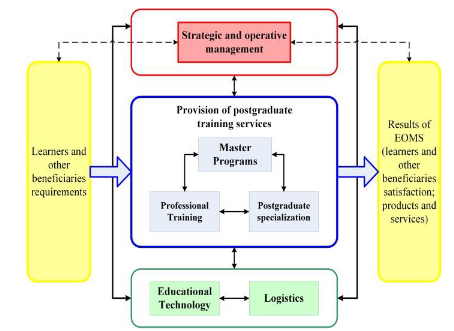
La Organización Internacional de Normalización publicó la norma ISO 21001 en 2018, que describe el sistema de gestión para organizaciones educativas. Este trabajo se centra en la implementación de los requisitos de la norma ISO 21001 dentro de una Cátedra colaborativa que ofrece servicios de formación académica de posgrado en la Universidad de La Habana en las áreas de normalización, metrología y sistemas integrados de gestión. El sistema de gestión de organizaciones educativas implementado abarca todos los procesos, personal y acciones necesarias para entregar servicios de formación de posgrado y productos educativos de calidad, evaluados con base en la satisfacción de los estudiantes y demás beneficiarios.
Downloads
References
[1] R. M. Guerra Bretaña, M. C. Meizoso Valdés, J. R. Ramírez García, y A. Iglesias Morell “Los programas de Maestría como canal de transferencia del conocimiento universidad-industria en Cuba”,COFIN Habana, no.1, pp. 1-22, enero-junio, 2017, [Online] Available:http://www.cofinhab.uh.cu/index.php/RCCF/article/view/205
[2] Sistemas de gestión de la calidad — Requisitos, Norma NC-ISO 9001, Oficina Nacional de Normalización (NC) La Habana, 2015.
[3] Educational organizations — Management systems for educational organizations — Requirements with guidance for use, ISO 21001 Standard, International Organization for Standardization (ISO) Geneva, 2018. [Online]. Available: https://www.iso.org/standard/66266.html
[4] Autores, “Aplicación de la norma ISO 21001:2018 a la calidad de los programas de posgrado académico”, Educación Médica Superior,Vol. 34, No. 1, p. e2050 [Online]. Available: http://www.ems.sld.cu/index.php/ems/article/view/2050
[5] T. V. Anh, N. T. M. Linh, H. T. T. Nguyen, and T. C. Duan “ISO Standard Application in University Management Model: A Case Study,” Int J Inform Educ Technol, vol. 11, no. 4, pp. 194-199 April 2021, DOI: 10.18178/ijiet.2021.11.4.1511
[6] Y. Rohayati, and R H Delvika, “Preparation for the Implementation of ISO 21001: 2018 using Assistance Program: Case study of Telkom Vocational High School,” in Proc. 12th ISIEM Batu Malang,Indonesia, pp. QM26-QM32, 2020, [Online] Available:https://isiem.net/wp-content/uploads/2020/06/QM-12th_ISIEM_2020_paper_57a.pdf
[7] M. C. Arrieta Prieto, and N. Estupiñán Romero, “Guía para la integración de las normas ISO-21001:2019 y NTC-5555:2011 para instituciones de educación para el trabajo y desarrollo humano,” M.Sc. Tesis, Universidad Santo Tomás – Convenio Icontec, Bogotá, Colombia, 2020.
[8] D. I. Quimi Franco, “Sistema de calidad enfocado a las normas ISO 9001 y 21001: caso Facultad de Ciencias Administrativas de la Universidad de Guayaquil,” Universidad y Sociedad, vol. 11, no. 1, pp. 279-88, enero, 2019, [Online] Available: https://rus.ucf.edu.cu/index.php/rus/article/view/1123
[9] N. V. Nhon, “Integrated QMS ISO 9001 and EOMS ISO 21001 to help educational institutions on their continuous improvement path-Best practices, Congress 2020, October 2020, Seoul, Korea. [Online]. Available: https://anq2020.org/download/?paperb=U0EyVTdmZ1V5SkFHU0t6MVNkbXpaUT09
[10] E. Wibisono, “The new management system ISO 21001:2018: What and why educational organizations should adopt it”, in International Seminar on Industrial Engineering and Management, Makassar, Indonesia, vol. 11th, 2018, [Online] Available: https://www.researchgate.net/publication/334549352
[11] O. Vasilevskyi, “Higher education quality system in the context of the ISO 21001:2018 implementation,” ISTCMTM, vol. 80, no. 4, pp.41-48, 2019 (Ukrainian), DOI: 10.23939/istcmtm2019.04.041
[12] International Organization for Standardization - ISO. “ISO 21001. Briefing Notes. Educational organization management systems,”International Organization for Standardization, Geneva, Switzerland, 2018 [Online] Available: https://www.iso.org/files/live/sites/isoorg/files/developing_standards/docs/en/ISO_21001_Briefing_Notes.pdf
[13] J. Anttila J, and K. Jussila, “Quality management in educational organizations,” J Qualit Educ, vol. 6, no. 7, pp. 9-13, April, 2017, DOI: 10.37870/joqie.v6i7.24
[14] M. A. Ron, and L. Rodríguez, “Unificar criterios de gestión en
organizaciones educativas,” AENOR, vol. 334, pp. 34-37, febrero, 2018, [Online] Available: https://dialnet.unirioja.es/servlet/articulo?codigo=6358038
[15] United Nations. “Transforming our world: the 2030 Agenda for Sustainable Development,” Division for Sustainable Development Goals, Department of Economic and Social Affairs United Nations. New York, NY, USA, September 2015. [Online] Available:ttps://sdgs.un.org/2030agenda
[16] E. Ordozgoiti, “Un mismo lenguaje en educación,” AENOR, vol. 303, pp. 30-33, abril, 2015, [Online] Available: https://www.une.org/normalizacion_documentos/educativos.pdf
[17] Quality management system-Guidelines for the application of ISO 9001:2000 in education, ISO/IWA 2, International Organization forStandardization (ISO) Geneva, 2007.
[18] Learning services outside formal education — Service requirements,ISO 29993 Standard, International Organization for Standardization(ISO) Geneva, 2017, [Online] Available: https://www.iso.org/standard/70357.html
[19] Quality management systems—Fundamentals and vocabulary, ISOStandard, International Organization for Standardization (ISO)Geneva, 2015 [Online] Available:https://www.iso.org/obp/ui/#iso:std:iso:9000:ed-4:v1:en
Downloads
-
Vistas(Views): 1600
- PDF (Español (España)) Descargas(Downloads): 886
- HTML (Español (España)) Descargas(Downloads): 86
Published
How to Cite
Issue
Section
License
Copyright (c) 2023 Scientia et Technica

This work is licensed under a Creative Commons Attribution-NonCommercial-ShareAlike 4.0 International License.
The undersigned authors declare that the article submitted to the journal Scientia et Technica is an original work and that all its content is free of third-party copyright restrictions or has the corresponding authorizations. Consequently, the authors assume responsibility for any litigation or claim related to intellectual property rights, releasing the Technological University of Pereira and the journal Scientia et Technica from any liability.
If the submitted work is accepted for publication, the authors retain copyright to the article and grant the journal Scientia et Technica the right of first publication, as well as a non-exclusive, perpetual license to reproduce, edit, distribute, display, and publicly communicate the article in any medium or format, including print, electronic, databases, repositories, the Internet, or other scientific dissemination systems. The authors agree that the article will be published in open access and distributed under the Creative Commons Attribution-NonCommercial-ShareAlike 4.0 International License (CC BY-NC-SA 4.0).
The journal Scientia will respect in all cases the moral rights of the authors, in accordance with the provisions of article 30 of Law 23 of 1982 of the Republic of Colombia, recognizing the authorship of the work, the right to integrity and the right of disclosure, which are inalienable and non-waivable.