


Computational simulation and voracious algorithm to calculate the least cost route
DOI:
https://doi.org/10.22517/23447214.24737Keywords:
Computational simulation, route optimization, supply chain, stochastic process, voracious algorithmAbstract
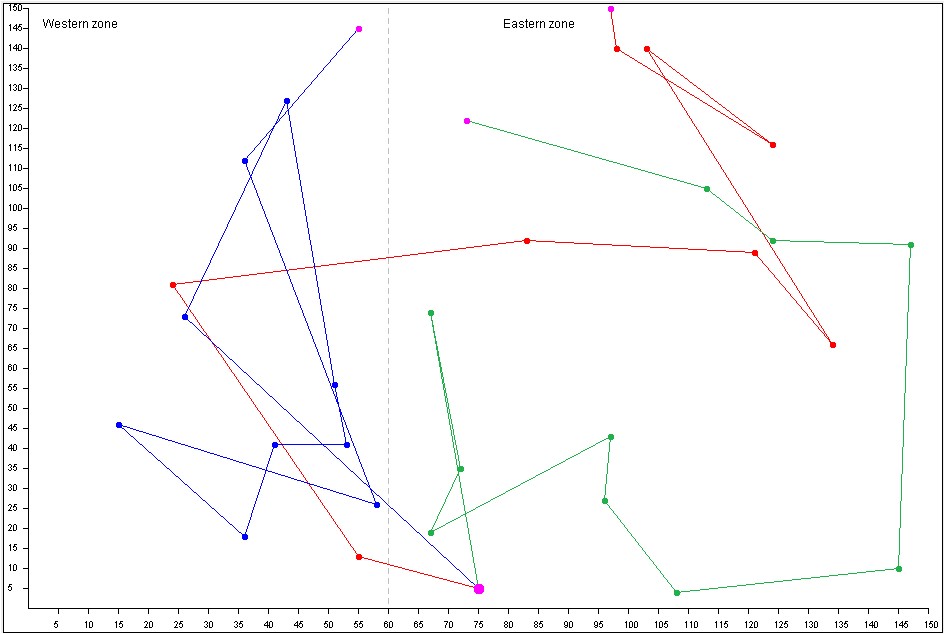
Transportation logistics aims to deliver products at the right time and place at the lowest possible cost. Within this activity are the problems of optimizing the routing of cargo vehicles that must travel a minimum cost route for the delivery of goods. The impact of the use of information technologies in the context of the supply chain can be measured basically in integration and in the benefits it brings. The objective of this research is to use computational simulation to evaluate restrictions of a messaging system and to show the shortest route found for three package delivery lines, optimizing the time and allocation of packages for each line. The project was developed under an empirical and exploratory methodology, where four phases followed. An algorithm was designed that used a voracious and stochastic approach, with an objective function that was evaluated in each of the n-simulations, to find the shortest route on the three delivery lines. To test the effectiveness of the algorithm, two test scenarios were carried out. In both scenarios, it was possible to show that the greater the number of simulations, the distance found was shorter, which was the objective of the investigation.
Downloads
References
[1] M. Shaiq et al., "Quality Management as Driver of Vertical Integration in Service Chain: A Study of 3rd Party Logistics Industry", Operations and Supply Chain Management, 13(3) pp. 224 - 255. 2020. DOI: https://doi.org/10.31387/oscm0420266
[2] S. Pattnaik, and S. Pattnaik, "Relationships Between Green Supply Chain Drivers, Triple Bottom Line Sustainability and Operational Performance: An Empirical Investigation in The UK Manufacturing Supply Chain", Operations and Supply Chain Management: An International Journal, 12(4), 198-211. 2019. DOI: https://doi.org/10.31387/oscm0390243
[3] Uvet, H, "Importance of Logistics Service Quality in Customer Satisfaction: An Empirical Study", Operations and Supply Chain Management: An International Journal, 13(1), 1-10. 2020. DOI: https://doi.org/10.31387/oscm0400248
[4] A. Batwa, and A. Norrman, "A Framework for Exploring Blockchain Technology in Supply Chain Management", Operations and Supply Chain Management: An International Journal, 13(3), 294-306. 2020. DOI: https://doi.org/10.31387/oscm0420271
[5] M. Abdul-Hak, N. Al-Holou, Y. Bazzi and M. Alamir Tamer, "Predictive Vehicle Route Optimization in Intelligent Transportation Systems", International Journal on Data Science and Technology, 5(1), pp. 14-28. 2019. DOI: https://doi.org/10.11648/j.ijdst.20190501.13
[6] H. Yalcin, W. Shi and Z. Rahman, "A review and scientometric analysis of supply chain management (SCM)", Operations and Supply Chain Management: An International Journal, 13(2), 123-133. 2020. DOI: https://doi.org/10.31387/oscm0410257
[7] A. Sharma and P. Khanna, "Relevance of Adopting Emerging Technologies in Outbound Supply Chain: New Paradigm for Cement Industry", Operations and Supply Chain Management: An International Journal, 13(2), 210-221. 2020. DOI: https://doi.org/10.31387/oscm0410263
[8] M. Akbari, "Logistics outsourcing: a structured literature review", Benchmarking: An International Journal, 25(5), pp. 1548-1580. 2018. DOI: https://doi.org/10.1108/BIJ-04-2017-0066
[9] J. Mageto and R. Luke, 'Skills frameworks: A focus on supply chains', Journal of Transport and Supply Chain Management, 14(0), 2020. DOI: https://doi.org/10.4102/jtscm.v14i0.458
[10] J. Alieva and R. Haartman, "Digital Muda - The New Form of Waste by Industry 4.0", Operations and Supply Chain Management: An International Journal, 13(3), 269-278. 2020. DOI: https://doi.org/10.31387/oscm0420268
[11] W. Yudhistyra, E. Risal and I. Raungratanaamporn, "Exploring Big Data Research: A Review of Published Articles from 2010 to 2018 Related to Logistics and Supply Chains", Operations and Supply Chain Management: An International Journal, 13(2), 134-149. 2020. DOI: https://doi.org/10.31387/oscm0410258
[12] R. Naudé and J. Badenhorst, 'The challenges behind producing a bottle of wine: Supply chain risks', Journal of Transport and Supply Chain Management, 14(0), 2020. DOI: https://doi.org/10.4102/jtscm.v14i0.471
[13] A. Botha and J. Badenhorst, 'Risk management in a bulk coal export logistic chain: A stakeholder perspective', Journal of Transport and Supply Chain Management 13(0), 2019. DOI: https://doi.org/10.4102/jtscm.v13i0.424
[14] M. Schneider, T. Gschwind and D. Vigo, "Advances in vehicle routing and logistics optimization: exact methods", EURO J Transp Logist, 8, 117-118. 2019. DOI: https://doi.org/10.1007/s13676-018-0139-6
[15] D.E. Mazzuco, et al., "A concept for simulation-based optimization in Vehicle Routing Problems", IFAC-PapersOnLine, 51(11), pp. 1720-1725. 2018. DOI: https://doi.org/10.1016/j.ifacol.2018.08.208
[16] M. Appiah and X. Qiang, "Route Optimization in logistics distribution based on Particle Swarm Optimization", International Journal of Computer Applications. 178. 23-27. 2019. DOI: https://doi.org/10.5120/ijca2019919179
[17] E. Huddiniah and M. ER, "Product Variety, Supply Chain Complexity and the Needs for Information Technology: A Framework Based on Literature Review", Operations and Supply Chain Management: An International Journal, 12(4), pp. 245-255. 2019. DOI: https://doi.org/10.31387/oscm0390247
[18] N. García, J. Moyano and J. Maqueira, "Planteamiento de un modelo de evaluación de lean supply chain management", Revista De Estudios Empresariales. Segunda Época, (1). 2019. DOI: https://doi.org/10.17561/ree.v2019n1.8
[19] M. Asrol, M. Yani and E. Taira, "Supply Chain Fair Profit Allocation Based on Risk and Value Added for Sugarcane Agro-industry", Operations and Supply Chain Management: An International Journal, 13(2), pp. 150-165. 2020. DOI: https://doi.org/10.31387/oscm0410259
[20] K. Salas, J. Meza, T. Obredor and N. Mercado, "Evaluación de la Cadena de Suministro para Mejorar la Competitividad y Productividad en el Sector Metalmecánico en Barranquilla, Colombia", Información tecnológica, 30(2), pp. 25-32. 2019. DOI: https://doi.org/10.4067/S0718-07642019000200025
[21] F. Caballero, O. Walteros and F. Santofimio, "Desarrollo y aplicación del Supply Chain Management en las empresas de marroquinería en Bogotá", Apuntes Contables. 24, 2019. pp. 107-123. DOI: https://doi.org/10.18601/16577175.n24.07
[22] E. Rodríguez, "La gestión de la cadena de suministro sostenible en la industria alimenticia", AD-minister, 33, pp. 113 - 134. DOI: https://doi.org/10.17230/ad-minister.33.6
[23] D. Ruiz, J. Bonilla and C. Masaquiza, "Ajuste estratégico en la cadena de suministros para la creación de valor de la marca Jean up", Revista Universidad y Sociedad, 10(1), pp. 25-32. 2018. Available at: http://scielo.sld.cu/scielo.php?script=sci_arttext&pid=S2218-36202018000100025&lng=es&tlng=es
[24] R. Huarote, Y. Vega, H. Aradiel and J. Valverde, "Optimización de ruta corta usando algoritmo genético generacional", Ciencia & Desarrollo, (22), pp. 50-57, 2019. DOI: https://doi.org/10.33326/26176033.2018.22.745
[25] Ma. Hajghasema and A. Abbas, "Optimal Routing in Supply Chain Aimed at Minimizing Vehicle Cost and Supply", Procedia Economics and Finance, 36, pp. 353-362. 2016. DOI: https://doi.org/10.1016/S2212-5671(16)30047-8
[26] J. Galarcio, et al., "Una nueva metaheurística aplicada al problema de ruteo de vehículos capacitados (cvrp) para la distribución de productos perecederos", Ingeniería E Innovación, 5(1). 2017. DOI: https://doi.org/10.21897/23460466.1107
[27] J. Velarde et al., "Optimization of territories and transport routes for hazardous products in a distribution network", Journal of Industrial Engineering and Management, 10(4), pp. 604-622, 2017. DOI: https://doi.org/10.3926/jiem.2107
[28] Y. Congli, "Optimization on Combination of Transport Routes and Modes on Dynamic Programming for a Container Multimodal Transport System", Procedia Engineering, 137, pp. 382-390, 2016. DOI: https://doi.org/10.1016/j.proeng.2016.01.272
[29] C. Osorio and K. Kumar, "Simulation-Based Optimization: Achieving Computational Efficiency Through the Use of Multiple Simulators", Home Transportation Science, 51(2), 2017. DOI: https://doi.org/10.1287/trsc.2016.0673
[30] M. Trigila, A. Gaudiani, E. Luque and M. Naiouf, "Simulación computacional, ciencia de los datos, cómputo de alto rendimiento y optimización aplicados a mejorar la predicción de modelos de simulación que representan la evolución de sistemas complejos", XX Workshop de Investigadores en Ciencias de la Computación. 2018. Available at: http://sedici.unlp.edu.ar/handle/10915/68228
[31] L. Lasso, D. Franco and A. Agudelo, "Voracious and Heuristic Algorithms: A focus on the Minimum Path Problem", INGE CUC, 16(2), 2020.
[32] I. MENES et al., "Simulación computacional de procesos de producción, caso de estudio: Proceso de producción de queso en la planta de lácteos FCP-ESPOCH", Revista Publicando, 4(3), pp. 248-265, 2017. Available at: https://revistapublicando.org/revista/index.php/crv/article/view/847
[33] M. Bučková, M. Krajčovi and M. Edl, "Computer Simulation and Optimization of Transport Distances of Order Picking Processes", Procedia Engineering, 192, pp. 69-74. 2017. DOI: https://doi.org/10.1016/j.proeng.2017.06.012
[34] F. Silva, et al., "Simulation Optimization for Analysis of Sustainable Logistics Systems", Pesquisa Operacional, 37(1), pp. 145-171. 2017. DOI: https://doi.org/10.1590/0101-7438.2017.037.01.0145
[35] J. Peng, "Optimizing the transportation route of fresh food in cold chain logistics by improved genetic algorithms", Int. J. Metrol. Qual. Eng. 10, 2019. DOI: https://doi.org/10.1051/ijmqe/2019013
[36] M. Hrušovský, et al., "Hybrid simulation and optimization approach for green intermodal transportation problem with travel time uncertainty", Flex Serv Manuf, 30, 486-516. 2018. DOI: https://doi.org/10.1007/s10696-016-9267-1
[37] Ch. Shaviraa and B. Kara-Sal, "Optimization methodology of intraurban transport routes of automobile passenger transport", Economics, 6(72), 2018.
[38] C. Iliopoulou and K. Kepaptsoglou, "Combining ITS and optimization in public transportation planning: state of the art and future research paths. EUR". Transp. Res. Rev. 11(27). 2019. DOI: https://doi.org/10.1186/s12544-019-0365-5
[39] C. Ma et al., "Distribution path robust optimization of electric vehicle with multiple distribution centers", PLoS ONE 13(3), 2018. DOI: https://doi.org/10.1371/journal.pone.0193789
Downloads
-
Vistas(Views): 855
- PDF Descargas(Downloads): 579
- HTML (Español (España)) Descargas(Downloads): 42
Published
How to Cite
Issue
Section
License
Copyright (c) 2023 Scientia et Technica

This work is licensed under a Creative Commons Attribution-NonCommercial-ShareAlike 4.0 International License.
The undersigned authors declare that the article submitted to the journal Scientia et Technica is an original work and that all its content is free of third-party copyright restrictions or has the corresponding authorizations. Consequently, the authors assume responsibility for any litigation or claim related to intellectual property rights, releasing the Technological University of Pereira and the journal Scientia et Technica from any liability.
If the submitted work is accepted for publication, the authors retain copyright to the article and grant the journal Scientia et Technica the right of first publication, as well as a non-exclusive, perpetual license to reproduce, edit, distribute, display, and publicly communicate the article in any medium or format, including print, electronic, databases, repositories, the Internet, or other scientific dissemination systems. The authors agree that the article will be published in open access and distributed under the Creative Commons Attribution-NonCommercial-ShareAlike 4.0 International License (CC BY-NC-SA 4.0).
The journal Scientia will respect in all cases the moral rights of the authors, in accordance with the provisions of article 30 of Law 23 of 1982 of the Republic of Colombia, recognizing the authorship of the work, the right to integrity and the right of disclosure, which are inalienable and non-waivable.